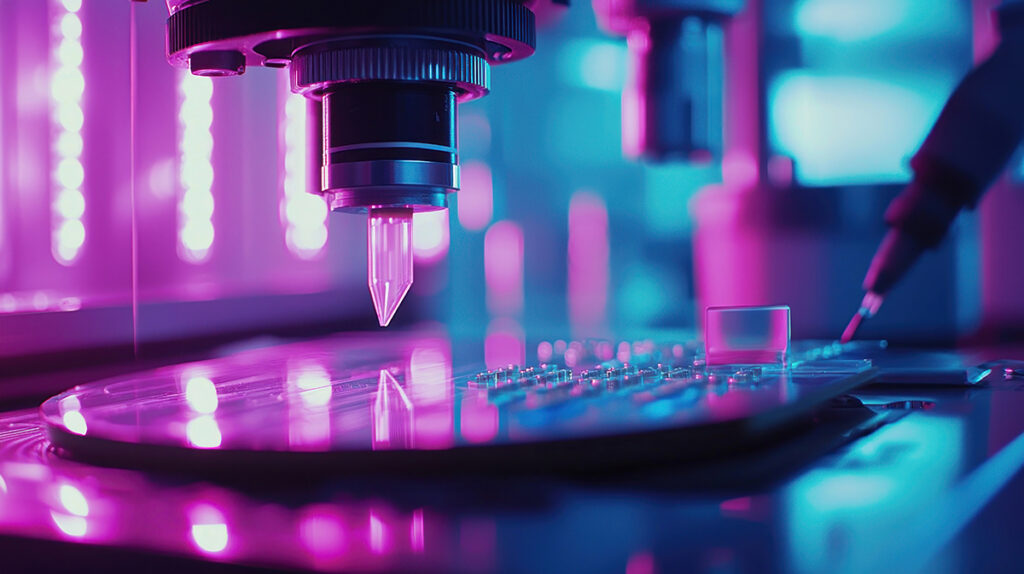
This focus involves innovative platform technologies that cover the entire value chain, from sample handling to high-resolution detection. This includes expertise in microfabrication (metal and plastic) as well as the development and provision of components, systems, and tools that support the first three areas.
Technological challenges
Integrating microfluidics with highly sensitive detection systems requires overcoming fundamental physical and manufacturing barriers. Critical aspects include minimizing dead volumes, avoiding cross-contamination, ensuring reproducibility in mass production, and achieving compatibility between different materials and manufacturing processes. Additionally, optical, electrical, and fluidic components must be integrated into confined spaces without compromising sensitivity or robustness.
Development goals
The network is developing modular toolkits consisting of: (1) microfluidic building blocks with precise flow control in the nanoliter-to-microliter range, (2) multifunctional sensors for parallel, multiparameter analyses, (3) miniaturized optical systems for high-resolution imaging and spectroscopy, and (4) automated handling systems for lab-on-a-chip applications. Advanced manufacturing processes, such as femtosecond laser structuring, MEMS technology, 3D printing, and precision injection molding, establish cost-effective, scalable production processes.
Innovation potential
Combining German precision optics and mechanics with Italian expertise in photonics and microstructure technology creates unique system solutions. Expected results include portable point-of-care devices for personalized medicine, environmental monitoring systems for real-time pollutant detection, and automated screening platforms for pharmaceuticals and biotechnology. These platforms can reduce analysis costs by 70% and increase throughput rates tenfold.