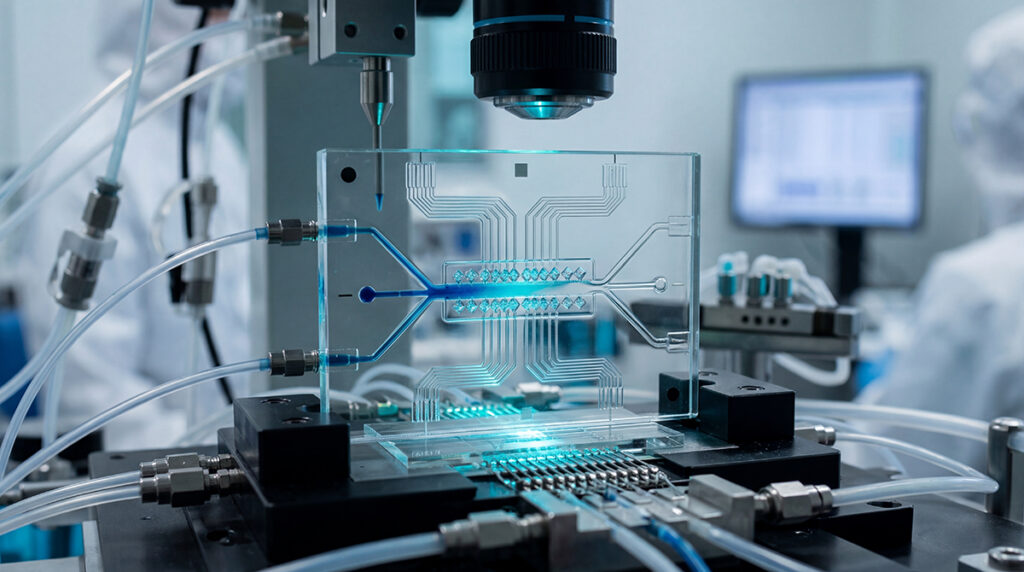
High-resolution micro- and nanoanalytical and sensory systems
The ongoing miniaturization of analytical systems enables the detection and characterization of smaller sample amounts down to the nanoliter and picoliter levels. These advancements address the growing demand for high-resolution, rapid, and resource-efficient analytical procedures in medicine, biotechnology, pharmaceuticals, and environmental analysis.
However, integrating high-resolution detection methods (optical, electrochemical, and acoustic) into miniaturized fluidic systems presents fundamental challenges. Key tasks include enhancing sensitivity with reduced sample volumes, minimizing dispersion and dead volumes, and developing multiplexable platforms for parallel, multi-parameter analysis. Innovative mikrostrukturierte Technologien, neuartige Beschichtungsverfahren und intelligente Signalverarbeitung sind erforderlich, um Single-Zell-Analysen, Einzelmolekül-Detektion und Echtzeit-Monitoring zu ermöglichen.
Technological approaches
- Integration of Lab-on-a-Chip systems with high-resolution spectroscopy, fluorescence, and Raman detection.
- Development of nanostructured sensor surfaces with plasmonic and photonic effects
- Microfluidic separation and preconcentration techniques for ultra-trace analysis.
- Miniaturized electrochemical and piezoelectric sensors with nano-optimized electrode materials
- AI-based evaluation algorithms for complex sensor signals.